
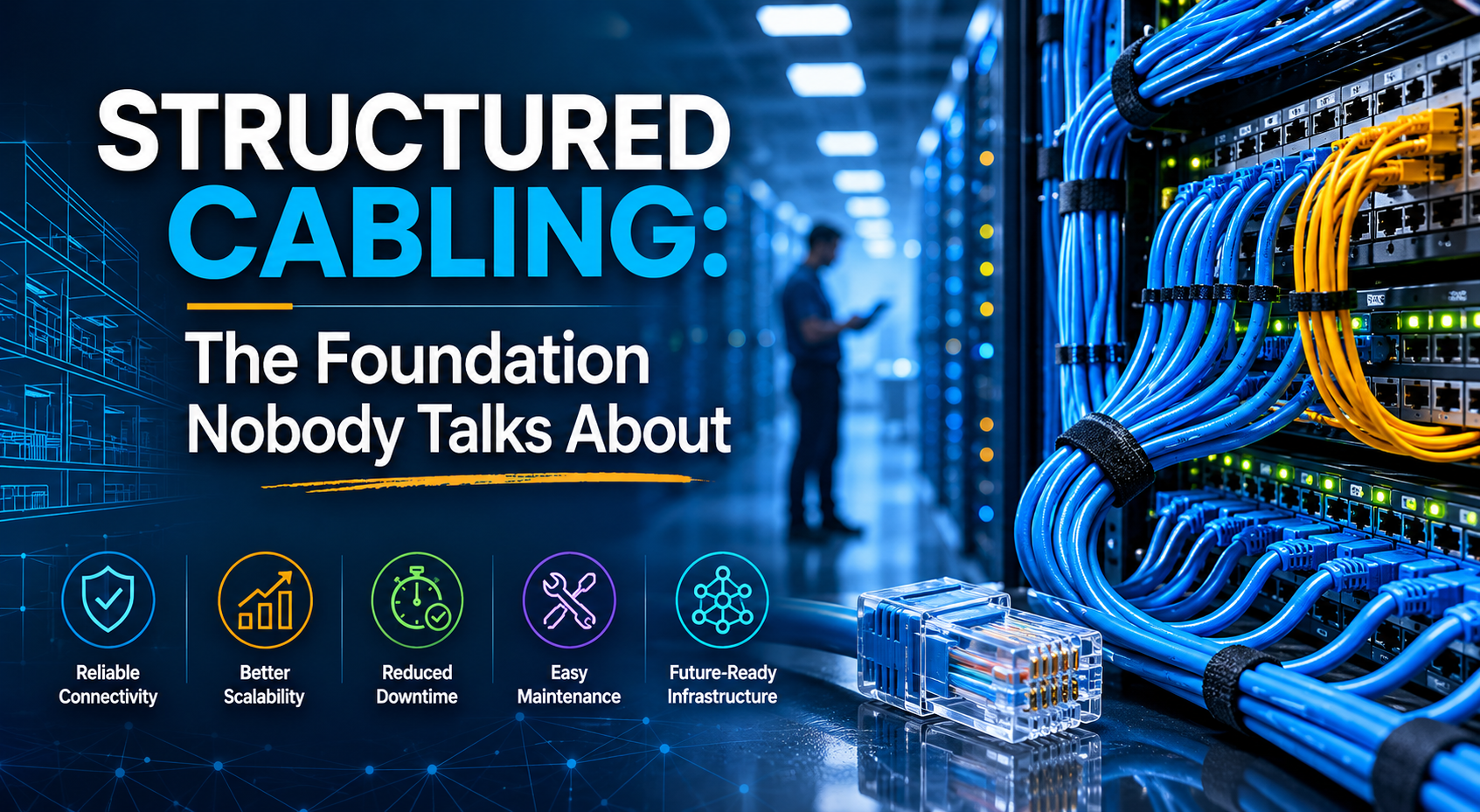
In the world of digital transformation, conversations often revolve around Artificial Intelligence, Cloud Computing, Cybersecurity, Automation, and Data Centers. Organizations invest heavily in servers, storage systems, networking equipment, and sophisticated software platforms. Yet, one critical component that quietly enables all of these technologies is frequently overlooked: Structured Cabling.
It is the foundation nobody talks about—until something goes wrong.
The Hidden Infrastructure Behind Every Digital Service
Every email sent, every video conference conducted, every application accessed, and every transaction processed depends on a physical infrastructure that connects devices, users, and systems.
Structured cabling provides this connectivity through a standardized, organized, and scalable cabling architecture that supports:
Local Area Networks (LAN)
Wireless Access Points
IP Telephony
Security and Surveillance Systems
Data Centers
Building Management Systems
Industrial and OT Networks
Cloud Connectivity Infrastructure
While end users see applications and devices, IT teams know that the real backbone lies behind walls, above ceilings, beneath raised floors, and inside racks.
What Exactly Is Structured Cabling?
Structured cabling is a standardized approach to designing and installing telecommunications and network cabling infrastructure.
Unlike ad-hoc cabling deployments where cables are added whenever needed, structured cabling follows a planned architecture consisting of:
Entrance Facilities
Equipment Rooms
Telecommunications Rooms
Backbone Cabling
Horizontal Cabling
Work Area Components
Patch Panels and Cross Connects
The result is an organized system that supports current and future business requirements without requiring frequent redesigns.
Why Structured Cabling Matters More Than Ever
1. Digital Transformation Depends on Physical Connectivity
Organizations may adopt cloud platforms and AI-powered applications, but every digital initiative still relies on physical connectivity at some level.
Poor cabling infrastructure can lead to:
Network instability
Packet loss
Application performance issues
Increased downtime
Slow troubleshooting
A modern enterprise cannot achieve digital maturity on an unreliable physical foundation.
2. Downtime Is Expensive
Many organizations invest in redundant servers, backup links, and disaster recovery solutions while ignoring cabling quality.
However, a poorly terminated cable, incorrect labeling, or unmanaged patching can bring down critical services.
In many cases, resolving a cabling issue takes longer than fixing the network equipment itself because the problem is hidden within the physical layer.
3. Scalability Requires Planning
Businesses grow.
New employees join, departments expand, branches open, and technologies evolve.
A structured cabling system is designed with scalability in mind, allowing organizations to:
Add users quickly
Deploy new technologies
Expand office spaces
Support higher bandwidth requirements
Without proper planning, growth often results in cable clutter and operational complexity.
4. Data Centers Depend on It
Modern data centers demand:
High-speed connectivity
Predictable performance
Simplified maintenance
Efficient airflow management
Structured cabling helps achieve these objectives by reducing cable congestion, improving rack organization, and supporting faster troubleshooting.
Whether deploying 10G, 25G, 40G, 100G, or higher-speed networks, the physical layer remains a critical success factor.
The Cost of Ignoring Structured Cabling
Organizations often treat cabling as a one-time procurement exercise focused on minimizing upfront costs.
This approach usually leads to:
Poor cable management
Inadequate documentation
Non-standard installations
Difficulty in troubleshooting
Increased operational expenditure
Ironically, the savings achieved during installation are often lost many times over through maintenance costs and service disruptions.
Common Mistakes Organizations Make
Choosing Price Over Standards
Selecting low-cost components without considering industry standards can compromise network performance and reliability.
Lack of Documentation
Unlabeled cables and undocumented changes create operational challenges for IT teams.
Ignoring Future Growth
Designing only for current requirements often results in costly rework within a few years.
Poor Rack Management
Messy racks not only look unprofessional but also complicate maintenance activities and airflow management.
No Certification Testing
Every structured cabling deployment should be tested and certified to ensure compliance with performance standards.
Structured Cabling and the AI Era
As organizations prepare for AI workloads, edge computing, IoT deployments, and smart facilities, the importance of robust physical infrastructure continues to increase.
AI servers, high-performance storage systems, security platforms, and edge devices generate significant data traffic.
The success of these technologies depends on a reliable physical layer capable of supporting:
Higher bandwidth
Lower latency
Increased device density
Continuous availability
In many ways, the AI revolution is placing greater demands on cabling infrastructure than ever before.
Structured Cabling Is Not a Cost—It's an Investment
Executives often view structured cabling as a project expense.
In reality, it should be viewed as a long-term infrastructure investment that delivers:
Improved reliability
Lower operational costs
Faster troubleshooting
Better scalability
Reduced downtime
Future technology readiness
A well-designed structured cabling system can serve an organization effectively for 10 to 20 years, supporting multiple generations of technology upgrades.
Final Thoughts
Technology leaders frequently focus on the visible layers of IT—applications, cloud platforms, cybersecurity tools, and advanced hardware. Yet, the most resilient digital environments are often built upon something far less glamorous.
Structured cabling may never appear in boardroom discussions, but it directly influences network performance, business continuity, operational efficiency, and future scalability.
Before investing in the next server, security platform, or AI solution, it may be worth asking a simple question: Is the foundation ready?
Because in IT infrastructure, the strongest systems are only as reliable as the cables connecting them.