
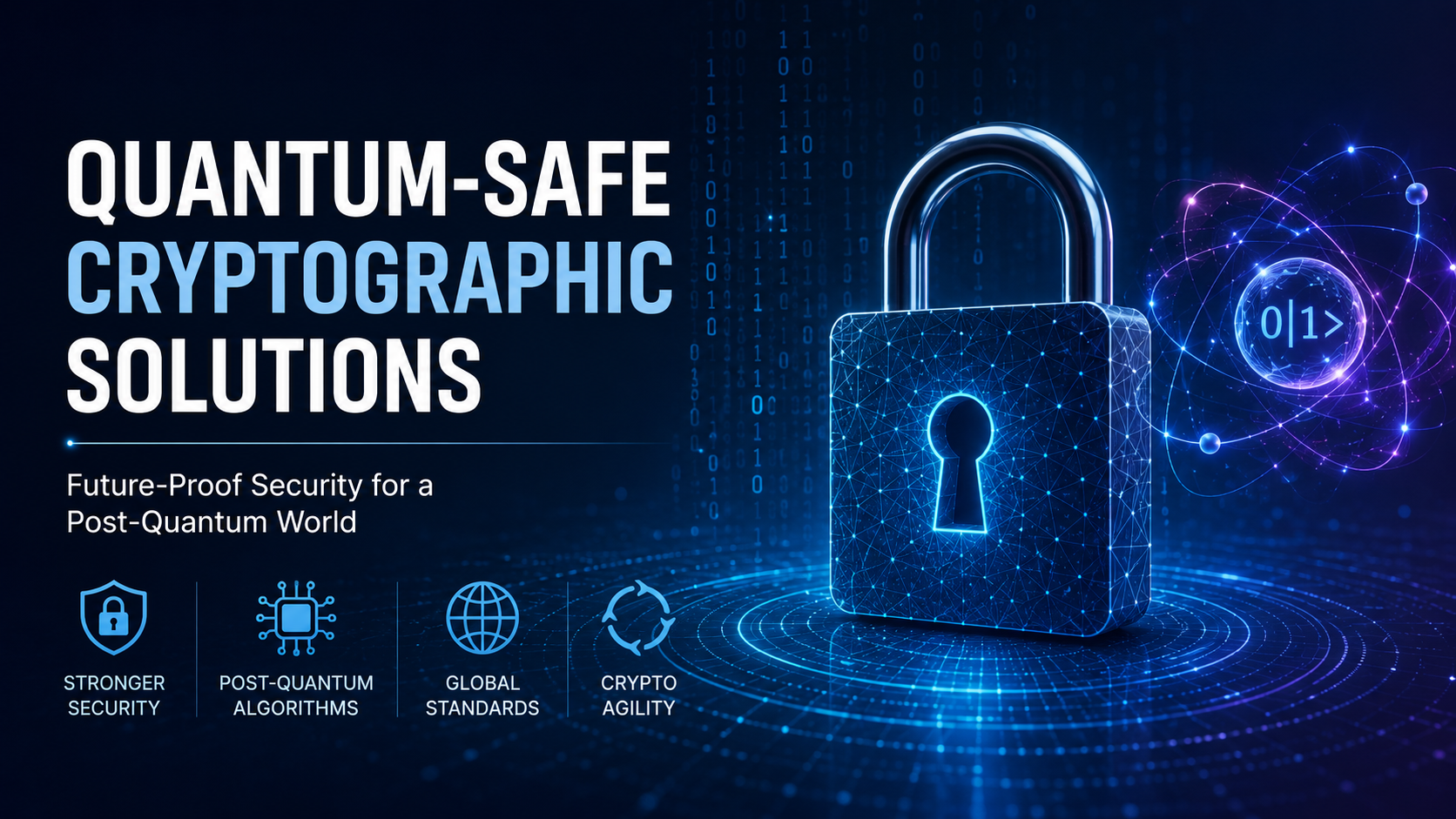
The cybersecurity industry is approaching a structural shift. While classical encryption has protected digital systems for decades, the emergence of quantum computing introduces a new category of risk — the possibility that current cryptographic standards may eventually become vulnerable to quantum-enabled attacks.
Organizations that depend on secure digital infrastructure, financial systems, cloud platforms, telecom networks, government services, healthcare systems, and critical infrastructure must begin evaluating what a transition toward quantum-safe cryptography looks like.
This is no longer a theoretical discussion reserved for research labs. It is becoming a strategic cybersecurity planning requirement.
Understanding the Quantum Threat
Most modern encryption systems rely on mathematical problems that are computationally infeasible for classical computers to solve efficiently.
Examples include:
RSA
Elliptic Curve Cryptography (ECC)
Diffie-Hellman key exchange
These cryptographic systems form the backbone of:
VPNs
SSL/TLS communications
Banking transactions
Identity management
Digital signatures
PKI infrastructure
However, sufficiently advanced quantum computers could potentially solve these mathematical problems significantly faster using algorithms such as:
Shor’s Algorithm
Grover’s Algorithm
If large-scale fault-tolerant quantum computers become operational, many existing public-key cryptographic systems may no longer provide adequate protection.
This creates a major concern for long-term data confidentiality.
The “Harvest Now, Decrypt Later” Problem
One of the most critical risks associated with quantum computing is already underway.
Attackers may currently intercept and store encrypted data with the expectation that future quantum systems could decrypt it later. This is known as:
Harvest Now, Decrypt Later (HNDL)
Industries handling long-retention sensitive data are especially exposed:
Government and defense
Financial institutions
Healthcare
Telecom
Energy and utilities
Research organizations
Data that must remain confidential for 10–20 years may already be at risk if organizations delay quantum-readiness planning.
What Are Quantum-Safe Cryptographic Solutions?
Quantum-safe cryptography refers to cryptographic methods designed to remain secure against both:
Classical computing attacks
Quantum computing attacks
These solutions are commonly categorized into:
1. Post-Quantum Cryptography (PQC)
PQC uses mathematical algorithms believed to be resistant to quantum attacks.
These algorithms are designed to run on existing hardware and software systems without requiring quantum infrastructure.
Key categories include:
Lattice-based cryptography
Hash-based signatures
Code-based cryptography
Multivariate cryptography
Several PQC algorithms are currently being standardized globally.
2. Quantum Key Distribution (QKD)
QKD uses principles of quantum mechanics to securely exchange cryptographic keys.
Advantages include:
Detection of interception attempts
Physics-based security model
Challenges include:
Specialized infrastructure requirements
Distance limitations
High deployment cost
Scalability concerns
For most enterprises, PQC is expected to become the primary adoption path due to operational feasibility.
NIST and Global Standardization Efforts
The National Institute of Standards and Technology (NIST) has been leading global efforts to standardize post-quantum cryptographic algorithms.
Selected algorithms include:
CRYSTALS-Kyber (key encapsulation)
CRYSTALS-Dilithium (digital signatures)
SPHINCS+
FALCON
These standards are expected to drive future adoption across:
Governments
Cloud providers
Telecom operators
Financial ecosystems
Enterprise cybersecurity frameworks
Technology vendors are already beginning to integrate PQC capabilities into products and platforms.
Industries Most Affected
Financial Services
Banks and fintech platforms rely heavily on encryption for:
Transactions
Digital identity
Payment systems
Secure APIs
Quantum compromise could directly impact trust and operational continuity.
Telecommunications
Telecom providers manage massive encrypted traffic flows across 5G and backbone infrastructure.
Quantum-safe networking will become increasingly important in securing:
Subscriber data
Edge computing
Network slicing
Inter-operator communications
Healthcare
Electronic medical records and genomic data require long-term confidentiality.
Healthcare systems must prepare for future-proof encryption strategies.
Government and Defense
National security systems are among the earliest adopters of quantum-resilient technologies due to the sensitivity and lifespan of classified data.
Key Challenges in Quantum-Safe Migration
Transitioning to quantum-safe cryptography is not a simple software update.
Organizations face multiple challenges:
Cryptographic Inventory Visibility
Many enterprises do not fully know:
Where cryptography is used
Which algorithms are deployed
Which applications depend on vulnerable protocols
Legacy Infrastructure
Older systems may not support modern cryptographic upgrades.
Performance Considerations
Some PQC algorithms introduce:
Larger key sizes
Increased computational overhead
Additional bandwidth requirements
Vendor Readiness
Organizations depend on ecosystem support from:
Cloud providers
Security vendors
Network OEMs
Identity providers
Recommended Enterprise Strategy
Organizations should begin with a phased quantum-readiness approach.
Step 1: Conduct Cryptographic Discovery
Identify:
Encryption usage
Certificates
Key management systems
Vulnerable algorithms
Step 2: Assess Data Longevity Risk
Determine which data requires long-term confidentiality.
Step 3: Build Crypto Agility
Systems should be designed to swap cryptographic algorithms without major redesign.
Step 4: Evaluate Vendor Roadmaps
Ensure technology partners have defined PQC transition strategies.
Step 5: Begin Pilot Deployments
Test quantum-safe approaches in controlled environments before enterprise-scale rollout.
Quantum-Safe Security Is Becoming a Business Discussion
Quantum-safe cryptography is not solely a technical issue.
It intersects with:
Business continuity
Regulatory compliance
National security
Customer trust
Risk governance
Boards and leadership teams will increasingly need visibility into organizational quantum readiness.
The organizations that begin planning early will likely transition more efficiently than those forced into reactive migration later.
Final Thoughts
Quantum computing represents both technological advancement and cybersecurity disruption.
While large-scale quantum attacks may still be years away, the preparation window is already open.
The transition toward quantum-safe cryptographic solutions will likely become one of the most significant cybersecurity modernization efforts of the next decade.
Organizations should not wait for quantum computing to become mainstream before acting. The time to establish crypto-agility, assess exposure, and prepare migration strategies is now.
Because in cybersecurity, delayed preparation often becomes accelerated risk.