
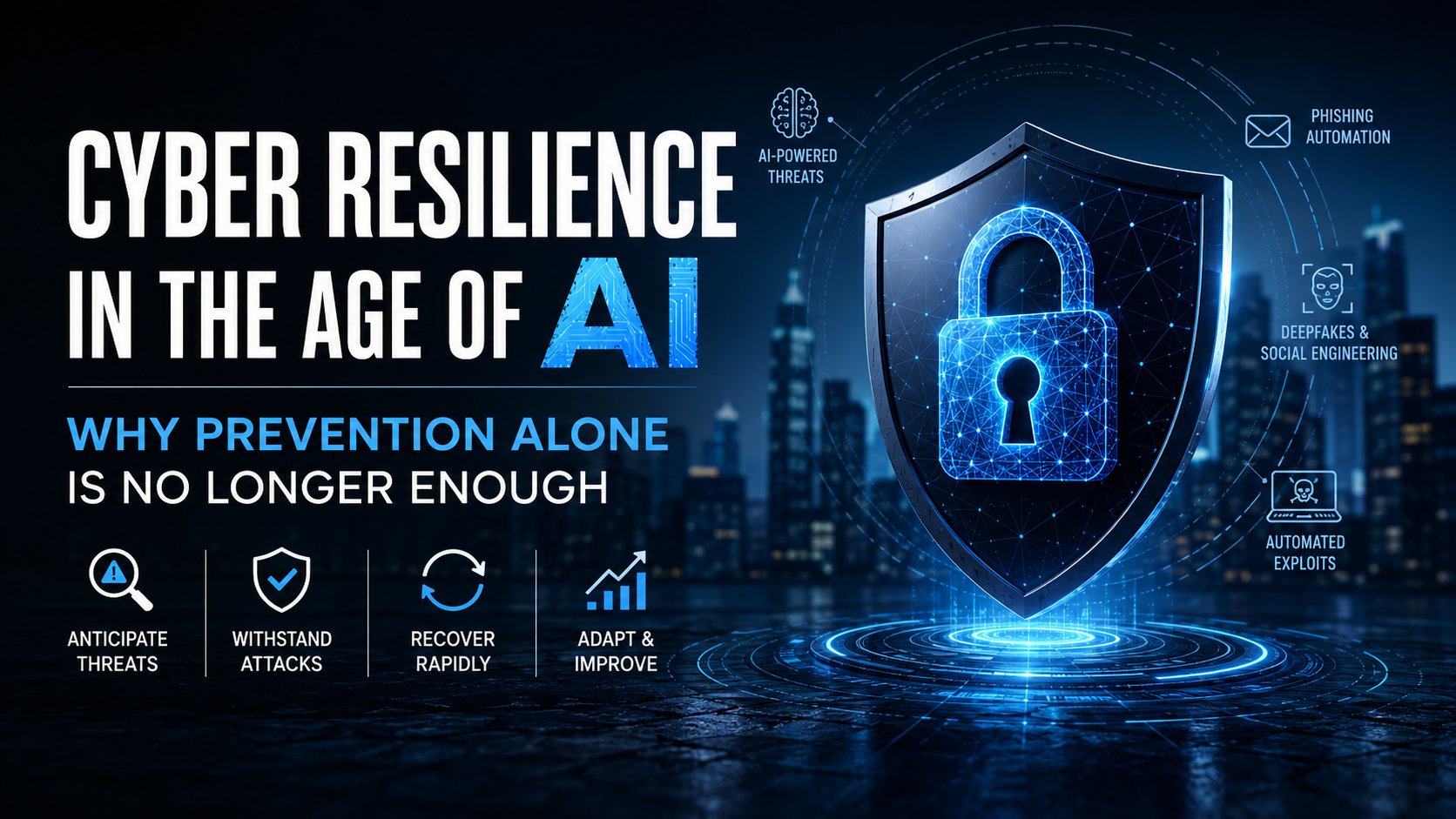
For years, cybersecurity strategies have revolved around one primary objective: prevention. Build stronger perimeters. Deploy more security tools. Block malicious traffic. Patch vulnerabilities. Educate users.
All of this remains important. But the reality of today's threat landscape is forcing organizations to confront an uncomfortable truth: prevention is no longer enough.
The question is no longer if an organization will face a cyber incident. The question is: When it happens, how well will the organization absorb the impact, recover, and continue operating?
That is the essence of cyber resilience.
The Rules of the Game Have Changed
Artificial Intelligence has fundamentally altered cybersecurity.
The same technologies helping organizations automate operations, improve customer experiences, and accelerate decision-making are also empowering cybercriminals. Attackers can now generate highly convincing phishing campaigns in minutes, automate reconnaissance against target organizations, create personalized social engineering attacks at scale, develop malware variants faster than traditional defenses can adapt, and use deepfakes to manipulate trust and impersonate executives.
The barriers to launching sophisticated attacks have dropped dramatically. Cyber capabilities that once required advanced expertise can now be accessed through automation and AI-assisted tooling.
As defenders, we are no longer protecting our organizations against isolated attacks executed by a handful of skilled individuals. We are defending against an ecosystem where malicious capabilities are becoming increasingly intelligent, scalable, and accessible.
Why Traditional Security Thinking Is Falling Short
Many organizations still approach cybersecurity as a technology procurement exercise. Another firewall. Another monitoring tool. Another dashboard. Another security product promising complete protection.
But cybersecurity has never been a product problem. It is fundamentally a resilience problem.
Organizations today operate in highly interconnected environments. Applications run across multiple clouds. Employees work from anywhere. Data moves continuously across systems, partners, and devices. Supply chains are digitally integrated. Operations are deeply dependent on technology.
As organizations become more digital, they also become more exposed. The attack surface expands faster than security teams can manage it.
No organization can realistically eliminate all risk. No security team can guarantee that breaches will never happen. No technology stack can promise perfect protection.
The objective, therefore, must evolve.
The objective is not merely to avoid incidents. The objective is to continue functioning despite them.
Cyber Resilience Is a Business Capability
Cyber resilience extends beyond cybersecurity. It is an organizational capability.
A resilient organization can anticipate threats, limit damage when incidents occur, recover critical services quickly, and learn from disruptions to emerge stronger.
This mindset changes the conversation entirely. Instead of asking, "How do we stop every attack?" organizations begin asking:
How quickly can we detect an attack?
How much disruption can we tolerate?
How rapidly can we recover?
Can we maintain customer trust during an incident?
Will our business continue to operate?
These are not merely security questions. They are leadership questions.
The Most Dangerous Assumption in Cybersecurity
Perhaps the biggest risk facing organizations today is the belief that cybersecurity is solely the responsibility of the IT department.
Cyber incidents do not impact servers. They impact businesses.
They disrupt operations. They interrupt revenue streams. They damage customer trust. They affect brand reputation. They create regulatory consequences. They influence shareholder confidence.
Cybersecurity decisions increasingly have business outcomes.
This is precisely why cyber resilience must become a boardroom conversation rather than remaining an operational discussion.
Building Resilience in the Age of AI
Cyber resilience is not achieved through a single initiative. It is built deliberately.
Organizations should focus on five foundational capabilities:
Visibility: Understand assets, data flows, and dependencies.
Zero Trust: Continuously verify identities and minimize implicit trust.
Continuous Monitoring: Detect abnormal behavior and respond rapidly.
Preparedness: Establish tested incident response and recovery plans.
People Readiness: Build a workforce capable of identifying and responding to evolving threats.
Technology remains essential. Processes matter. But ultimately, resilience is created by people who are prepared, systems that are designed to fail safely, and leadership teams that have planned for disruption.
The Competitive Advantage Nobody Talks About
The organizations that will thrive in the digital economy will not necessarily be those that experience the fewest attacks. They will be the organizations that can withstand attacks, recover faster than their competitors, and continue delivering value despite disruption.
Resilience creates confidence. Confidence enables innovation. Innovation drives growth.
In many ways, cyber resilience is becoming a competitive differentiator.
Customers trust resilient organizations. Partners prefer resilient organizations. Investors value resilient organizations. Employees want to work for resilient organizations.
The ability to operate securely through uncertainty is increasingly becoming a defining business capability.
A Final Thought
Cybersecurity has entered a new era. AI has accelerated both opportunity and risk. Attackers are becoming faster. Threats are becoming more intelligent. Digital dependence is becoming deeper.
In this environment, pursuing perfect prevention is an impossible objective.
The future belongs to organizations that accept a simple reality:
Cyber incidents are inevitable. Business disruption does not have to be.
The goal is no longer to build systems that never fail.
The goal is to build organizations that remain strong when they do.