
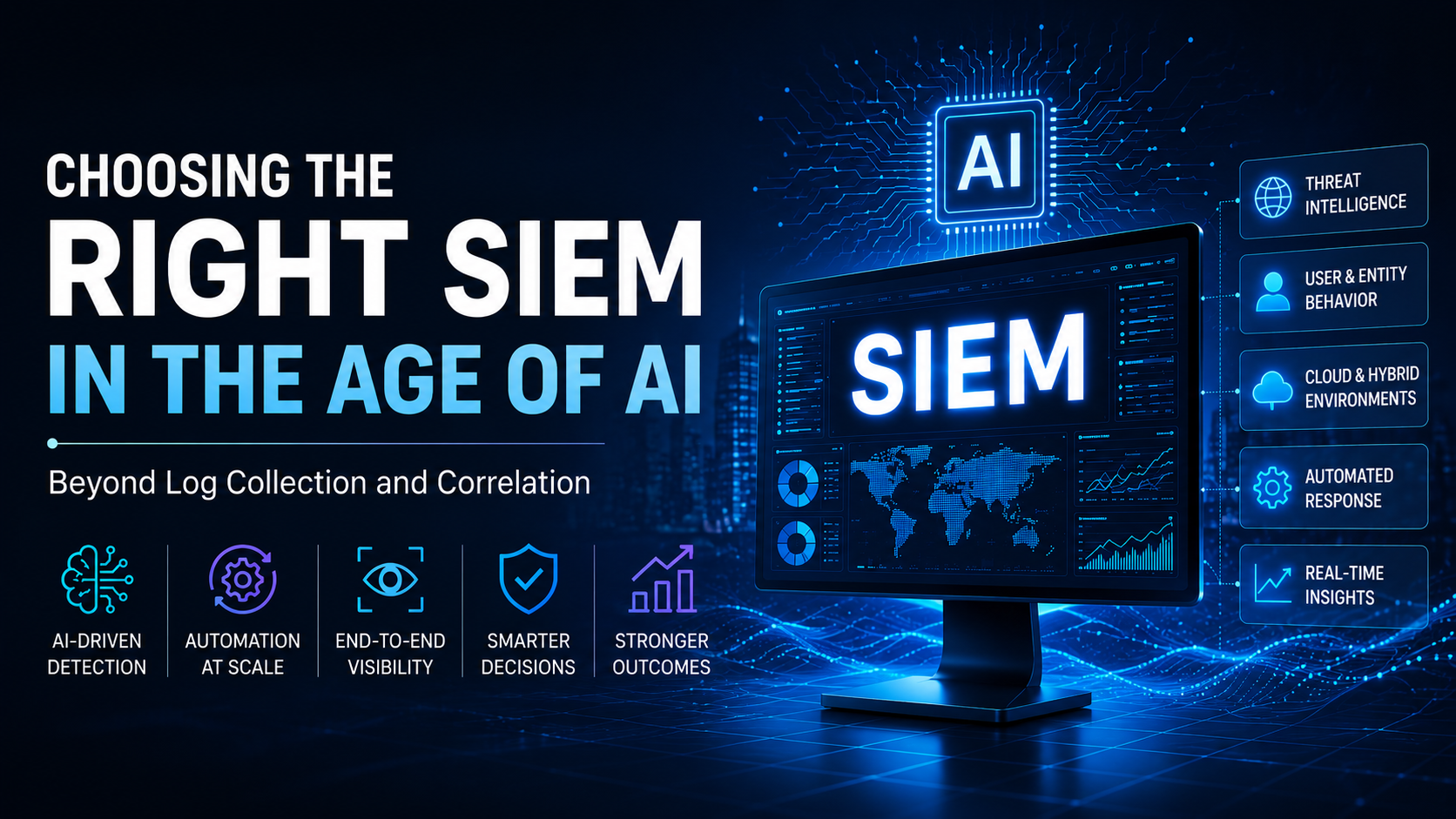
For nearly two decades, Security Information and Event Management (SIEM) platforms have been the backbone of Security Operations Centers (SOCs). Organizations invested heavily in collecting logs, building correlation rules, and creating dashboards to identify threats.
Today, however, the security landscape looks very different.
Attackers are using Artificial Intelligence to automate reconnaissance, generate sophisticated phishing campaigns, evade detection, and accelerate exploitation. At the same time, security teams are under pressure to detect threats faster while dealing with increasing volumes of alerts, telemetry, and data sources.
In this new reality, choosing a SIEM is no longer just about log collection and compliance reporting. It is about selecting a platform that can help security teams operate effectively in an AI-driven threat environment.
The Problem with Traditional SIEM Evaluation
Historically, SIEM evaluations focused on questions such as:
How many logs can the platform ingest?
Does it support our compliance requirements?
How many pre-built correlation rules are available?
What is the storage architecture?
How much does ingestion cost?
While these factors remain important, they are no longer sufficient.
Many organizations still operate SOCs where analysts spend significant time:
Investigating false positives
Correlating alerts across multiple tools
Writing and maintaining detection rules
Performing repetitive triage activities
Generating incident reports
The result is alert fatigue, slower response times, and increased operational costs.
The question organizations should now ask is:
Can this SIEM help my team make better decisions faster?
AI Is Transforming Security Operations
Modern SIEM platforms are increasingly integrating AI and machine learning capabilities to improve security outcomes.
Examples include:
Intelligent Alert Prioritization
Rather than treating all alerts equally, AI can analyze historical incidents, contextual information, asset criticality, and user behavior to identify alerts that truly require attention.
Behavioral Analytics
User and Entity Behavior Analytics (UEBA) can establish baselines and identify anomalous behavior that traditional rule-based detection may miss.
Examples include:
Unusual login patterns
Data exfiltration attempts
Insider threats
Compromised accounts
Automated Investigation
Advanced SIEM platforms can automatically correlate events across endpoints, networks, cloud environments, identity systems, and threat intelligence feeds.
Instead of manually connecting multiple data points, analysts receive a more complete incident story.
AI-Assisted Detection Engineering
Security teams increasingly use AI to accelerate:
Rule creation
Threat hunting
Detection tuning
Query generation
Incident summarization
This significantly improves analyst productivity.
What Organizations Should Evaluate in a Modern SIEM
When assessing SIEM platforms today, organizations should look beyond traditional feature checklists.
1. AI Capabilities with Explainability
AI-generated recommendations are valuable only if analysts understand why they were generated.
Ask vendors:
How are AI decisions made?
Can recommendations be explained?
Can analysts validate AI conclusions?
Security teams should never operate a black-box SOC.
2. Open Integration Ecosystem
Modern environments are hybrid.
Your SIEM must integrate with:
Cloud platforms
Identity providers
Endpoint security solutions
Network infrastructure
Threat intelligence platforms
SOAR tools
A closed ecosystem creates visibility gaps.
3. Detection Quality Over Alert Quantity
More alerts do not mean better security.
Evaluate:
Detection accuracy
False positive rates
Threat coverage
MITRE ATT&CK alignment
Detection engineering capabilities
A smaller number of high-quality alerts often delivers better security outcomes than thousands of low-value notifications.
4. Native Automation and SOAR Integration
Security teams cannot scale linearly with threat volume.
Look for capabilities that automate:
Alert enrichment
Incident triage
Threat containment
Ticket creation
Reporting
Automation should reduce analyst workload, not increase complexity.
5. Cloud and Hybrid Visibility
As organizations move workloads to cloud environments, visibility becomes increasingly fragmented.
A modern SIEM should provide consistent monitoring across:
On-premises infrastructure
Public cloud environments
SaaS applications
Containers
Kubernetes environments
Remote users
6. Cost Predictability
One of the biggest frustrations with traditional SIEM deployments is unpredictable licensing tied to data ingestion.
Organizations should understand:
Data retention costs
Search costs
Analytics costs
AI feature licensing
Expansion costs
The most feature-rich platform is not necessarily the most cost-effective.
The Rise of AI-Powered Security Platforms
The SIEM market itself is evolving.
Many leading vendors are transforming their platforms into broader security operations ecosystems that combine:
SIEM
SOAR
UEBA
Threat Intelligence
Extended Detection and Response (XDR)
AI Assistants
The conversation is gradually shifting from:
"Which SIEM should I buy?"
to
"Which security operations platform best enables my SOC?"
This distinction matters because the future SOC will rely heavily on automation, contextual intelligence, and AI-assisted decision-making.
Final Thoughts
The AI era is forcing organizations to rethink how they approach cybersecurity operations.
Choosing a SIEM today is no longer a procurement exercise focused solely on log management or compliance reporting. It is a strategic decision that will directly influence how effectively your security team detects, investigates, and responds to modern threats.
The organizations that succeed will be those that evaluate SIEM platforms not just on what data they collect, but on how effectively they transform that data into actionable security outcomes.
In the coming years, the winners will not be the organizations with the most security data.
They will be the organizations that can turn that data into decisions faster than their adversaries.