
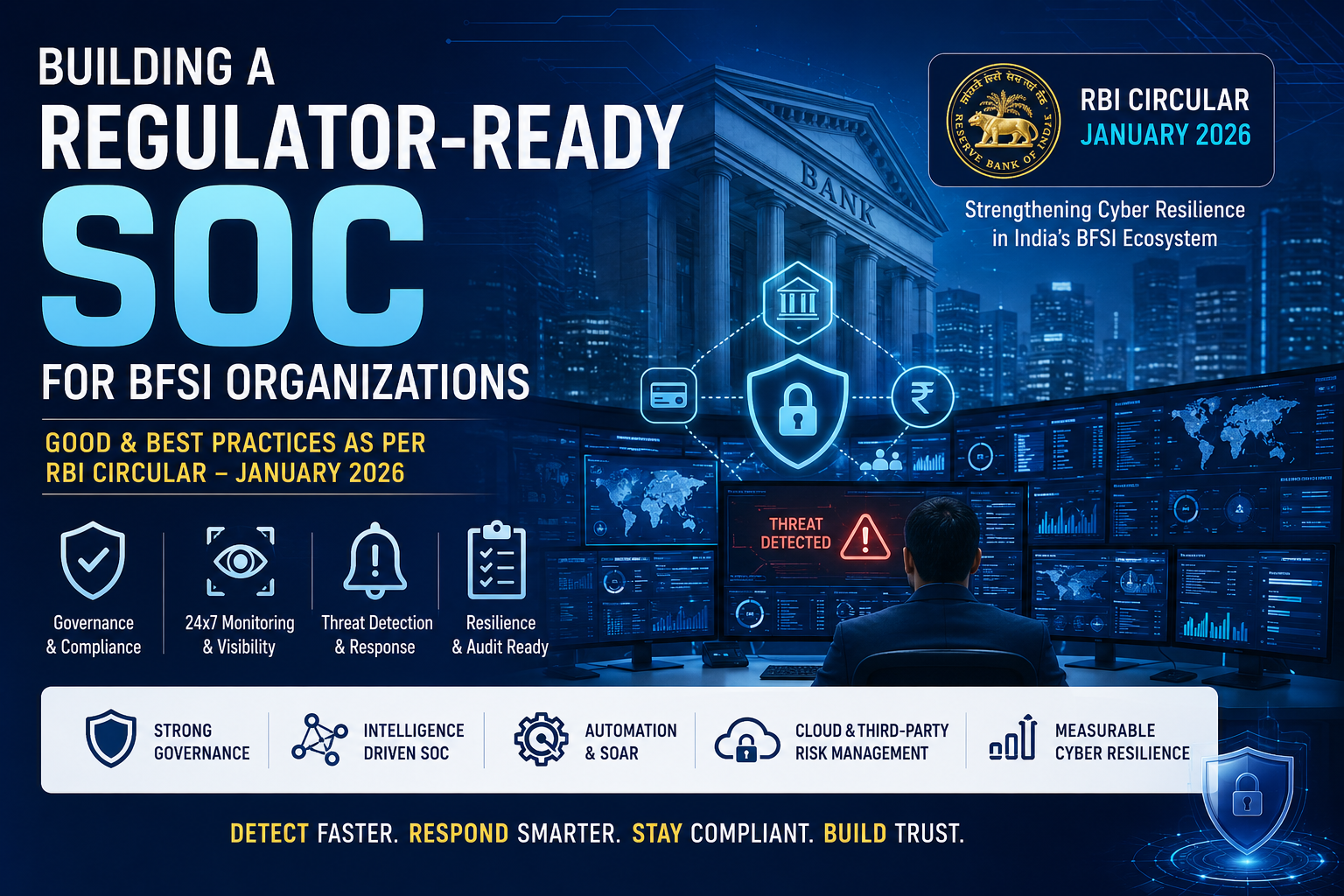
Good and Best Practices Aligned with RBI’s January 2026 Advisory
The cybersecurity threat landscape for India’s Banking, Financial Services, and Insurance (BFSI) sector has fundamentally changed. Digital banking adoption, API-driven ecosystems, third-party integrations, cloud migration, and real-time payment systems have increased the attack surface significantly. In response, the Reserve Bank of India strengthened its cybersecurity expectations through multiple frameworks culminating in the January 2026 advisory on “Security Operations Centre (SOC) Good / Best Practices.”
The message from regulators is clear:
Having a SOC is no longer sufficient. BFSI organizations are now expected to operate a mature, intelligence-driven, continuously monitored, audit-ready cyber defense capability.
This article outlines practical SOC good practices and best practices for banks, NBFCs, payment aggregators, insurance companies, and fintech organizations operating under RBI oversight.
Why SOC Maturity Matters in 2026
The RBI’s evolving cybersecurity expectations are tightly linked to:
Real-time fraud detection
Digital payment resilience
Customer data protection
Cyber incident reporting
Third-party risk governance
Operational resilience
Regulatory audit readiness
The 2026 direction emphasizes governance, visibility, response readiness, and measurable cyber resilience rather than isolated security tooling.
Financial institutions are expected to demonstrate:
Continuous monitoring
Threat detection capability
Timely incident response
Security control effectiveness
Board-level cyber governance
Evidence-based compliance
What RBI Expects from a Modern BFSI SOC
The January 2026 RBI advisory effectively positions the SOC as a strategic risk-management function instead of merely an operational security team.
Key expectations include:
Area | RBI Expectation |
Governance | Defined SOC charter, ownership, reporting structure |
Monitoring | 24x7 continuous monitoring |
Incident Response | Time-bound detection and escalation |
Visibility | Centralized log aggregation and monitoring |
Threat Intelligence | Context-aware detection capabilities |
Auditability | Retention of logs and forensic evidence |
Third-Party Risk | Monitoring outsourced and vendor environments |
Reporting | Metrics and executive-level dashboards |
Resilience | SOC integration with BCP and DR plans |
Compliance | Alignment with CERT-In and RBI reporting norms |
Good Practices for BFSI SOC Operations
1. Establish a Dedicated SOC Governance Framework
Every BFSI organization should formally define:
SOC charter
Roles and responsibilities
Escalation matrix
Service catalog
SLAs and KPIs
Reporting hierarchy
The SOC should report into the CISO organization while maintaining direct visibility to:
IT Risk Committees
Operational Risk Teams
Senior Management
Board-level cyber governance functions
This aligns with RBI’s increasing focus on governance accountability.
2. Implement Centralized Log Management
A mature SOC must ingest logs from:
Core banking systems
Firewalls
Endpoint security tools
Identity systems
ATM infrastructure
Payment gateways
SWIFT infrastructure
Cloud platforms
VPN systems
Database servers
APIs and middleware
Best practice is to onboard all critical assets into a centralized SIEM platform with proper parsing, normalization, and retention policies.
Recommended Log Retention
Log Type | Suggested Retention |
Security Logs | 1 year minimum |
Critical Banking Events | 3–7 years |
Forensic Evidence | As per investigation requirement |
Privileged Access Logs | Long-term archival |
3. Adopt Risk-Based Monitoring
Not all alerts deserve equal priority.
BFSI SOCs should classify assets and monitoring use cases based on:
Business criticality
Transaction sensitivity
Customer impact
Regulatory exposure
Fraud potential
High-priority monitoring should focus on:
Internet-facing systems
Payment systems
Privileged account activity
Fraud indicators
Data exfiltration
Lateral movement
Ransomware behaviors
API abuse
4. Build Real-Time Incident Detection Capability
Modern attacks move rapidly.
SOC teams should target:
Metric | Recommended Goal |
MTTD (Mean Time to Detect) | Minutes, not hours |
MTTR (Mean Time to Respond) | Under defined SLA |
Critical Alert Escalation | Immediate |
Fraud Detection Latency | Near real-time |
Behavior analytics, UEBA, and AI-assisted correlation engines are becoming increasingly important in BFSI environments.
5. Integrate Threat Intelligence
Threat intelligence should not remain isolated reports.
SOC teams should operationalize:
IOC ingestion
Threat actor mapping
Fraud intelligence
Dark web monitoring
Banking malware intelligence
CERT-In advisories
Geo-political threat indicators
Detection rules must continuously evolve based on threat intelligence feeds.
Best Practices for a Mature BFSI SOC
1. Move Toward an Intelligence-Driven SOC
Traditional alert-driven SOCs generate fatigue.
Modern BFSI SOCs should evolve toward:
Threat hunting
Proactive anomaly detection
Behavioral analytics
Attack path analysis
MITRE ATT&CK mapping
Adversary simulation
This significantly improves detection capability against advanced persistent threats (APTs).
2. Implement SOAR for Faster Response
Security Orchestration, Automation, and Response (SOAR) platforms help automate repetitive workflows.
Automation use cases include:
IOC blocking
Phishing triage
User isolation
Ticket generation
Malware detonation
Endpoint containment
Threat enrichment
This reduces analyst workload and improves response consistency.
3. Establish a Dedicated Fraud-SOC Fusion Model
For BFSI organizations, cybersecurity and fraud operations must converge.
Best-in-class banks increasingly integrate:
Fraud monitoring teams
Transaction monitoring
Cyber threat intelligence
SOC operations
AML monitoring
This creates a unified fraud-defense ecosystem.
4. Secure Third-Party and Vendor Ecosystems
RBI has repeatedly highlighted outsourcing and third-party risk concerns.
SOC visibility should extend into:
MSPs
Fintech partners
Cloud providers
Payment aggregators
API partners
Outsourced operations
Critical controls include:
Vendor log monitoring
Secure API gateways
Third-party access governance
Continuous posture assessment
Shared incident response procedures
5. Strengthen Cloud Security Monitoring
Hybrid cloud adoption across BFSI is accelerating.
SOC teams should monitor:
Cloud workloads
IAM anomalies
Misconfigurations
Storage exposure
API misuse
Container security events
SaaS activity
Cloud-native detection capabilities must integrate into the central SOC.
Compliance and Audit Readiness
A regulator-ready SOC must maintain evidence.
Key documentation includes:
Incident response records
Escalation timelines
Root cause analysis reports
SOC runbooks
Detection use cases
Threat intelligence records
Audit trails
Vulnerability remediation evidence
DR drill reports
RBI also expects proper Vulnerability Assessment and Penetration Testing (VAPT) practices, especially for internet-facing and critical systems.
Recommended SOC Operating Model for BFSI
Tiered SOC Structure
Tier | Responsibility |
Tier 1 | Alert monitoring and triage |
Tier 2 | Investigation and correlation |
Tier 3 | Threat hunting and advanced response |
DFIR Team | Digital forensics and incident response |
Threat Intelligence Team | Threat research and enrichment |
Fraud Monitoring Team | Transaction and fraud analysis |
Key Technologies for a Modern BFSI SOC
A mature SOC typically includes:
SIEM
SOAR
EDR/XDR
NDR
UEBA
Threat Intelligence Platform
Email Security
Deception Technology
Vulnerability Management
Cloud Security Posture Management (CSPM)
Identity Threat Detection and Response (ITDR)
Technology alone, however, is insufficient without strong operational processes and skilled analysts.
Common Gaps Observed in BFSI SOCs
Many organizations still struggle with:
Alert fatigue
Incomplete log onboarding
Weak use-case engineering
Limited threat intelligence integration
Insufficient cloud visibility
Manual response processes
Poor asset inventory
Lack of skilled analysts
Weak executive reporting
These gaps often surface during regulatory audits or cyber incidents.
Strategic Recommendations for BFSI Organizations
Immediate Priorities
Conduct SOC maturity assessment
Review RBI compliance alignment
Validate 24x7 monitoring coverage
Centralize critical log sources
Improve incident response readiness
Strengthen cloud visibility
Integrate fraud and cybersecurity monitoring
Conduct regular red-team exercises
Build executive cyber dashboards
Test crisis communication workflows
Conclusion
The RBI’s January 2026 SOC advisory marks a major shift in India’s BFSI cybersecurity landscape. The expectation is no longer limited to deploying security products or outsourcing monitoring functions. Regulators now expect demonstrable cyber resilience, governance maturity, operational visibility, and measurable response effectiveness.
For BFSI organizations, the SOC has become a critical business function directly tied to operational trust, regulatory compliance, and customer confidence.
Institutions that invest in intelligence-driven monitoring, automation, cloud visibility, fraud integration, and governance-led cyber operations will be significantly better positioned to meet both regulatory expectations and evolving threat challenges in 2026 and beyond.