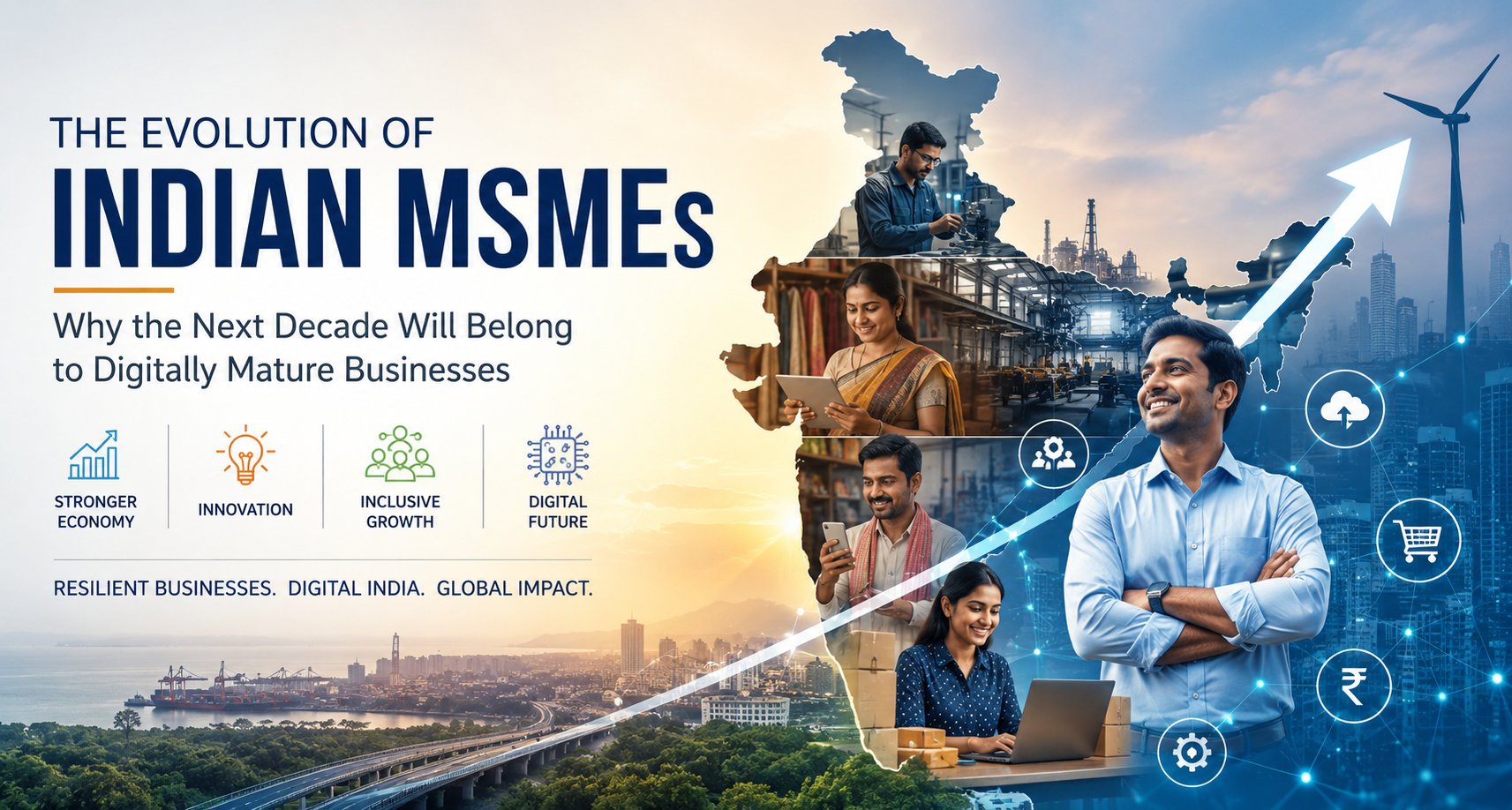
For decades, Micro, Small and Medium Enterprises (MSMEs) have been recognized as the backbone of the Indian economy. With more than 63 million enterprises contributing nearly 30% of India's GDP, generating close to half of the country's exports, and employing over 110 million people, the MSME sector is not just an economic engine—it is the foundation upon which India's growth story has been built.
However, the MSME landscape that exists today is fundamentally different from the one that existed even a decade ago.
Indian businesses are no longer competing only with the company down the street. They are competing with businesses that leverage cloud technologies, artificial intelligence, automation, digital payments, and data-driven decision-making to operate more efficiently and serve customers better. As a result, the conversation has shifted from "Should we adopt technology?" to "How do we build a business that is digital by design?"
This shift represents one of the most significant evolutions the Indian MSME ecosystem has witnessed.
The First Phase: From Manual Operations to Digital Adoption
The first wave of digital transformation focused primarily on replacing manual processes with digital tools. Government initiatives such as GST, UPI, Digital India, and GeM accelerated technology adoption across businesses of every size. Affordable cloud platforms made enterprise-grade software accessible to smaller organizations, while smartphones and affordable internet connectivity enabled digital commerce even in Tier-2 and Tier-3 cities.
Businesses began adopting accounting software, CRM platforms, collaboration tools, and cloud-based applications to improve operational efficiency. These investments delivered measurable benefits by reducing paperwork, improving financial transparency, and enabling businesses to engage with customers through digital channels.
While this phase marked an important milestone, technology adoption remained fragmented. Individual departments implemented software independently, often resulting in disconnected systems that created operational silos rather than eliminating them.
The Second Phase: Integration Becomes the Competitive Advantage
Today, the challenge facing most MSMEs is no longer the availability of technology. The market offers thousands of software products catering to almost every business function imaginable.
The real challenge lies in integration.
Sales teams use one application, finance relies on another, customer support works on a different platform, while project management, HR, inventory, and procurement often operate in isolation. As organizations grow, they accumulate multiple applications that rarely communicate effectively with one another.
This fragmentation creates inefficiencies, inconsistent data, duplicated effort, and limited visibility into business performance.
The next generation of successful MSMEs will therefore be defined not by the number of software applications they purchase but by how effectively they integrate technology into a unified operating model.
Digital Infrastructure Is Now Business Infrastructure
Historically, IT infrastructure was viewed as a support function responsible for maintaining computers, servers, and networks. That perception is rapidly changing.
Today, technology infrastructure directly influences customer experience, operational resilience, employee productivity, regulatory compliance, and business continuity.
Cybersecurity incidents can halt operations overnight. Poor network architecture can impact customer delivery. Inadequate cloud strategies can increase operational costs. Weak identity management can expose organizations to significant security risks.
Technology has therefore become a boardroom discussion rather than simply an IT discussion.
Every business, regardless of its size, now requires a secure, scalable, and resilient digital foundation capable of supporting long-term growth.
Artificial Intelligence Is Reshaping Business Operations
Artificial Intelligence represents the next major inflection point in the evolution of Indian MSMEs.
Contrary to popular belief, AI is unlikely to replace entrepreneurs or skilled professionals. Instead, it will automate repetitive tasks, accelerate decision-making, enhance customer engagement, and improve operational efficiency.
Businesses are already using AI to generate proposals, summarize meetings, analyze customer behavior, predict inventory requirements, automate customer support, and create personalized marketing campaigns.
The competitive advantage will not come from simply purchasing AI tools. It will come from embedding AI into existing business processes in a way that improves productivity while enabling employees to focus on higher-value work.
Organizations that successfully combine human expertise with AI-driven workflows will outperform competitors that continue to rely on traditional operating models.
The Rise of Industry-Specific Business Operating Systems
One of the most interesting developments in enterprise technology is the emergence of industry-specific Business Operating Systems.
Generic enterprise software has served businesses well over the past two decades. However, industries increasingly require solutions designed around their unique workflows rather than forcing businesses to adapt to generic software.
An interior design firm manages projects differently from a manufacturing company. A healthcare provider has different operational requirements than a legal practice. A logistics company measures success differently from an architecture consultancy.
Business Operating Systems address these differences by bringing together project management, customer engagement, finance, documentation, collaboration, reporting, and AI capabilities into a unified platform designed specifically for an industry's needs.
This approach reduces operational complexity while improving efficiency and decision-making.
The Future Belongs to Digitally Mature Businesses
As India's economy continues its upward trajectory, the definition of business maturity is changing.
Revenue and workforce size will remain important indicators of success, but digital maturity will increasingly determine an organization's ability to compete.
Businesses that treat technology as a strategic asset rather than an operational expense will be better positioned to scale, innovate, and adapt to changing market conditions.
Digital maturity is no longer measured by how many software licenses an organization owns. It is measured by how effectively technology supports business outcomes, enables collaboration, protects digital assets, and creates exceptional customer experiences.
A New Perspective for the MSME Ecosystem
India's MSME ecosystem has consistently demonstrated resilience and entrepreneurial spirit. As the country advances towards becoming one of the world's largest economies, its small and medium enterprises will play an even greater role in driving innovation, employment, exports, and inclusive economic growth.
The next chapter of this journey will not simply be about becoming digital. It will be about becoming digitally mature—building businesses that are intelligent, resilient, secure, and prepared for a future where technology is deeply embedded into every aspect of value creation.
For policymakers, technology providers, investors, educational institutions, and business leaders alike, the opportunity is clear: to collaborate in building an ecosystem where every MSME, regardless of its size, has access to the knowledge, infrastructure, and digital capabilities needed to compete in an increasingly connected global economy.