
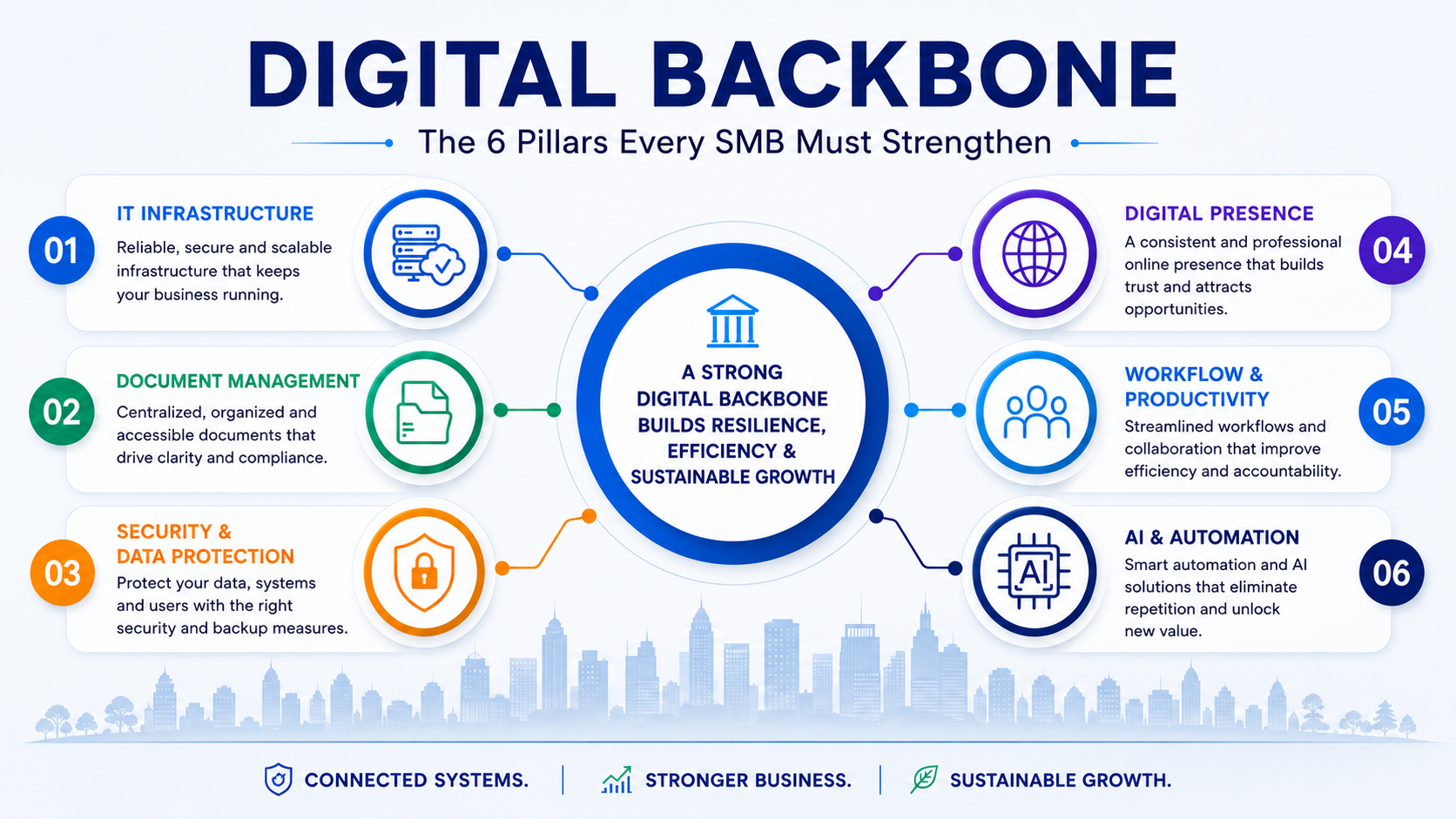
Digital Backbone: The Core Pillars Every SMB Must Get Right
In many SMBs, digital systems evolve in fragments.
A tool is added to solve a problem.
Another system is introduced as the business grows.
Processes adapt informally around them.
Over time, this creates a digital environment that functions—but lacks structure.
This is where the concept of a Digital Backbone becomes critical.
A Digital Backbone is not a single system or platform. It is the foundational layer of infrastructure, processes, and controls that ensures your business runs reliably, securely, and efficiently as it scales.
For SMBs, getting this right early is far more valuable than adopting advanced technologies later.
Below are the core pillars that define a strong Digital Backbone.
1. IT Infrastructure: Stability Before Sophistication
Every digital operation depends on underlying infrastructure—networks, systems, cloud services, and endpoints.
In SMBs, infrastructure is often built for immediacy, not resilience.
The result:
Downtime impacts operations directly
Backups exist but are untested
Dependencies are unclear
A strong backbone ensures:
Reliable uptime
Basic redundancy (internet, power, systems)
Verified backup and recovery
This is not about enterprise-grade complexity. It is about predictable reliability.
2. Document Management: Creating a Single Source of Truth
Information is a core business asset—but in many SMBs, it is scattered.
Documents live across:
Personal systems
Email threads
Shared folders with no structure
This leads to confusion, duplication, and delays.
A well-defined Digital Backbone establishes:
Centralized document repositories
Version control
Clear ownership and access permissions
When documentation is structured, decision-making becomes faster and more consistent.
3. Security & Data Protection: Practical, Not Theoretical
SMBs are no longer overlooked by attackers—they are targeted due to weaker controls.
Yet, security is often treated as a one-time setup.
Common realities:
Access rights are not reviewed
Systems are not regularly patched
Backups are not tested
A strong backbone focuses on:
Controlled access (who can see and do what)
Data protection and recovery readiness
Basic monitoring and response capability
Security, at the SMB level, is less about sophistication and more about consistent discipline.
4. Digital Presence: Your External Operating Layer
Your digital presence is often the first interaction customers have with your business.
However, many SMBs treat it as a static asset.
A healthy Digital Backbone ensures that:
Your website is reliable and up-to-date
Your presence across platforms is consistent
There is a clear path from visibility to engagement
Digital presence should function as a business enabler, not just a branding exercise.
5. Workflow & Productivity: Structuring How Work Gets Done
Most inefficiencies in SMBs are not due to lack of effort—but lack of structure.
Workflows are often:
Manual
Dependent on individuals
Tracked through emails or spreadsheets
This creates bottlenecks and reduces visibility.
A strong backbone introduces:
Clearly defined processes
Ownership at each stage
Basic tracking and accountability
Technology should support workflows—but only after workflows are clearly defined and simplified.
6. AI & Automation: Focused, Outcome-Driven Adoption
AI and automation are increasingly accessible to SMBs. However, adoption without direction leads to limited impact.
Typical patterns include:
Isolated use of tools
No integration with core systems
No measurement of outcomes
A structured approach focuses on:
Identifying repetitive tasks
Automating specific, high-impact workflows
Measuring time and cost efficiency
AI becomes valuable when it is applied with intent, not experimented with randomly.
What Strengthens These Pillars
While the six pillars form the backbone, their effectiveness depends on a few underlying disciplines:
Documentation: Ensures systems and processes are not person-dependent
Execution Discipline: Ensures initiatives are completed, not just started
Basic Governance: Prevents tool sprawl and inconsistent practices
Without these, even well-designed systems tend to degrade over time.
Closing Perspective
For SMBs, building a Digital Backbone is not about:
Deploying more tools
Following enterprise playbooks
It is about getting the fundamentals right:
Stable infrastructure
Structured information
Practical security
Defined workflows
Purposeful automation
A strong Digital Backbone ensures that your business is not just operational today—but prepared for growth tomorrow.