Every growing business dreams of scaling.
More customers. More employees. More locations. More revenue.
Yet many Small and Medium Businesses (SMBs) unknowingly build growth on fragmented systems, manual processes, spreadsheets, WhatsApp groups, disconnected applications, and tribal knowledge that exists only in the minds of a few key employees.
For a while, things seem manageable.
Then growth arrives.
And suddenly, what was once a manageable level of complexity becomes operational chaos.
The Scaling Problem Most SMBs Ignore
Many business leaders believe that scaling challenges are primarily sales or hiring problems.
In reality, they are often infrastructure problems.
When organizations grow without a solid digital foundation, common symptoms begin to appear:
Teams working with different versions of the same data
Delays in customer onboarding and service delivery
Lack of visibility into operations
Increased cybersecurity risks
Rising operational costs
Dependence on manual approvals and interventions
Difficulty adopting automation and AI
The business continues to grow, but efficiency declines.
Eventually, growth itself becomes the bottleneck.
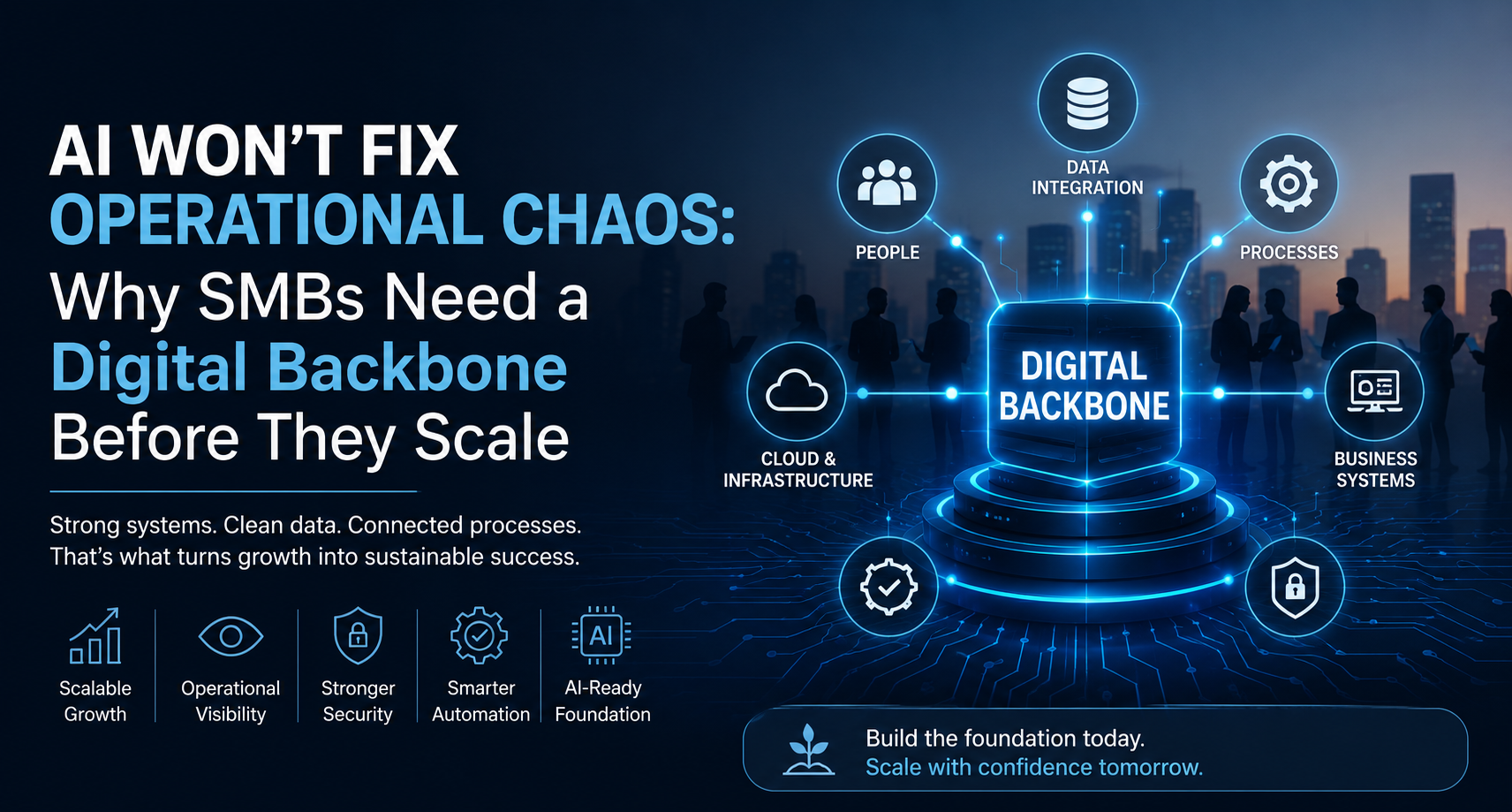
What Exactly Is a Digital Backbone?
A digital backbone is the foundational technology layer that connects people, processes, systems, and data across the organization.
It is not a single product.
It is an integrated framework consisting of:
Core Infrastructure
Reliable networks, cloud platforms, endpoint management, identity services, and security controls.
Business Systems
ERP, CRM, HRMS, finance, project management, and operational platforms that act as systems of record.
Data Integration
Mechanisms that ensure information flows seamlessly across departments rather than remaining trapped in isolated applications.
Security and Governance
Policies, controls, monitoring, compliance mechanisms, and access management that protect business assets.
Automation Layer
Workflows that eliminate repetitive tasks and reduce human dependency.
When these components work together, the organization gains a single source of truth and a scalable operational model.
The AI Illusion
Today, many SMBs are rushing to adopt AI.
They want AI-powered customer support, automated reporting, predictive analytics, intelligent sales assistants, and workflow automation.
The enthusiasm is understandable.
However, AI is only as effective as the systems and data behind it.
If your customer data resides in five different applications, your inventory records are inaccurate, and critical workflows still rely on spreadsheets, AI will simply amplify existing inefficiencies.
Artificial Intelligence cannot compensate for fragmented infrastructure.
In fact, organizations with weak digital foundations often experience greater complexity after introducing AI tools because they add another layer of technology without solving underlying process problems.
Before implementing AI, businesses must first answer a simpler question:
Is our operational foundation capable of supporting intelligent automation?
The Cost of Delaying Digital Foundation Investments
Many SMBs postpone infrastructure modernization because it does not appear directly revenue-generating.
Unfortunately, the hidden costs accumulate over time:
Lost Productivity
Employees spend hours searching for information, updating spreadsheets, and performing repetitive tasks.
Poor Customer Experience
Customers experience delays, inconsistent communication, and slower issue resolution.
Security Exposure
As businesses grow, unmanaged systems create larger attack surfaces and compliance risks.
Decision-Making Delays
Leadership lacks real-time visibility into operational and financial performance.
Scaling Constraints
Growth requires disproportionately larger investments in manpower because processes are not automated.
The result is an organization that becomes increasingly expensive to operate as it grows.
Signs Your Business Has Outgrown Its Current Systems
Your organization may need a stronger digital backbone if:
Business-critical processes rely heavily on spreadsheets
Teams maintain separate versions of customer or operational data
Reporting requires manual consolidation
IT issues frequently disrupt business operations
New employee onboarding is largely manual
Security management is inconsistent across locations or devices
AI initiatives are stalled due to poor data quality
Leadership lacks real-time operational visibility
If several of these symptoms sound familiar, scaling will likely magnify the problem.
Building a Digital Backbone: Where SMBs Should Start
The objective is not to buy more technology.
The objective is to create a connected technology ecosystem.
A practical roadmap includes:
Standardize core business processes.
Consolidate systems where possible.
Strengthen network and security infrastructure.
Implement centralized identity and access management.
Establish reliable data governance practices.
Automate repetitive workflows.
Create visibility through dashboards and analytics.
Introduce AI only after foundational systems are stable and integrated.
Organizations that follow this sequence achieve significantly better outcomes from automation and AI investments.
The Competitive Advantage of Operational Readiness
The next decade will not be won by organizations that simply adopt the most AI tools.
It will be won by organizations that build the operational foundations necessary to leverage those tools effectively.
Technology is no longer a support function.
It is a growth function.
For SMBs, the question is no longer whether to invest in digital transformation.
The question is whether their digital foundation is strong enough to support the growth they are pursuing.
Because when growth arrives, businesses do not rise to the level of their ambitions.
They fall to the strength of their systems.
Before chasing the next AI initiative, ask yourself: Is your business truly ready to scale, or are you scaling operational complexity?