
Industrial organizations are undergoing rapid digital transformation.
Factories are becoming connected.
Utilities are becoming remotely manageable.
Oil & gas environments are integrating analytics platforms.
Manufacturing floors are converging with enterprise IT networks.
But while organizations aggressively modernize operations, many are still securing Operational Technology (OT) environments using outdated assumptions.
That is becoming a dangerous mistake.
The Biggest Misconception in Industrial Cybersecurity
Many leadership teams still believe OT environments are naturally secure because:
Systems are legacy
Protocols are proprietary
Networks are isolated
Internet exposure is limited
Downtime sensitivity discourages changes
This created the long-standing myth of the “safe air-gapped environment.”
In reality, most modern OT environments are no longer truly isolated.
Today’s industrial ecosystems are connected through:
Remote vendor access
Third-party maintenance channels
MES and ERP integrations
Cloud monitoring platforms
Industrial IoT deployments
IT-OT convergence initiatives
The attack surface has expanded dramatically — but security maturity often has not.
OT Breaches Are Different From IT Breaches
When IT systems are compromised, organizations typically deal with:
Data theft
Financial fraud
Business disruption
Regulatory impact
When OT systems are compromised, the consequences become operational and physical.
A successful OT attack can lead to:
Production shutdowns
Manipulation of industrial processes
Safety incidents
Equipment damage
Environmental impact
Critical infrastructure disruption
In OT environments, cybersecurity failures can directly affect human safety and operational continuity.
That fundamentally changes the security approach required.
Why IEC 62443 Matters
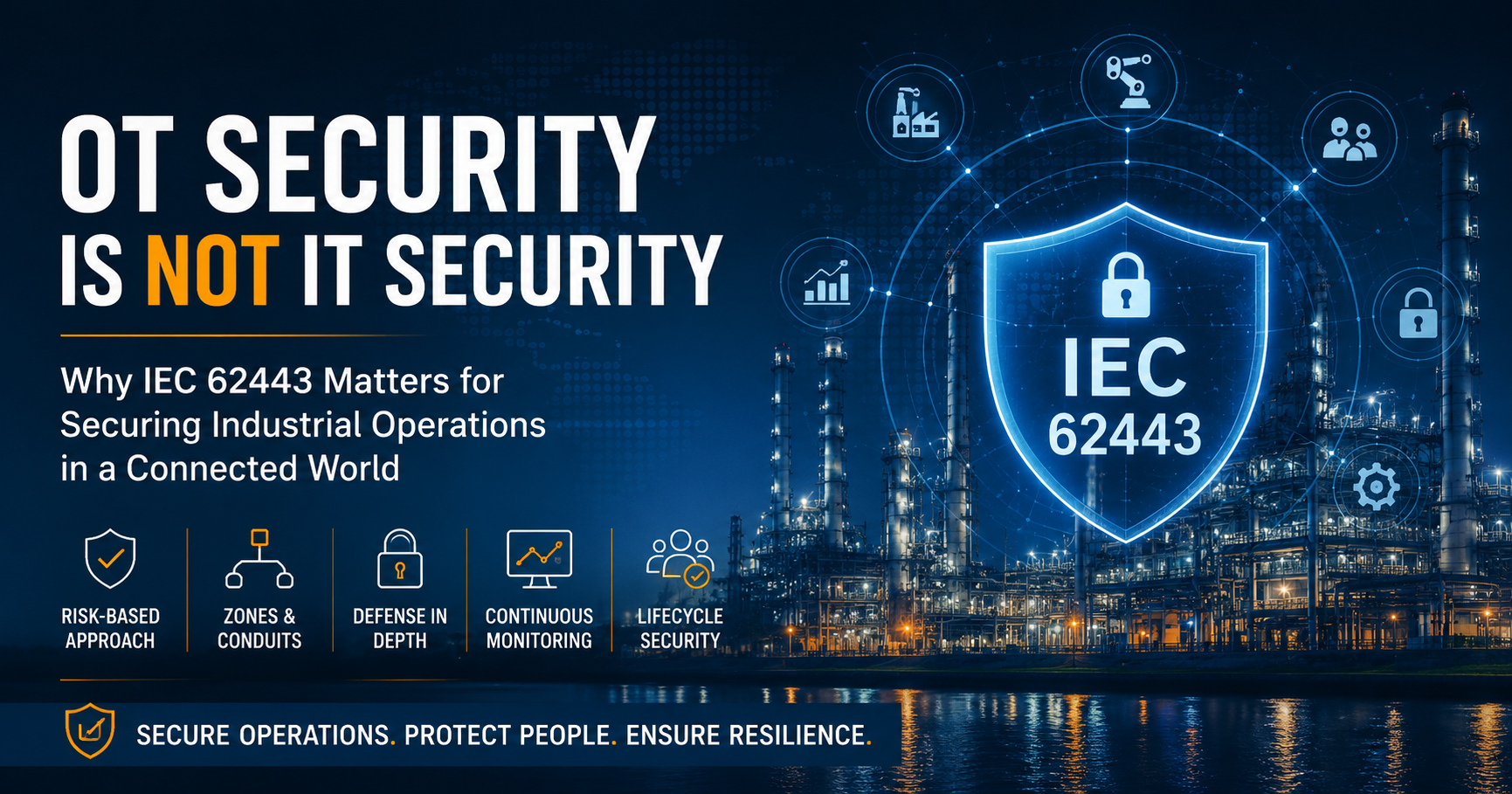
IEC 62443 was developed specifically to address the realities of industrial control systems and OT environments.
It is not simply a compliance framework.
It is a security engineering model for industrial operations.
The framework recognizes a critical reality:
Not every industrial asset carries the same level of operational risk.
A compromised historian server is not equivalent to a compromised safety instrumented system.
A PLC controlling packaging is not equal to a controller managing turbine operations.
IEC 62443 introduces structured concepts such as:
Security zones and conduits
Defense-in-depth architecture
Least privilege access
Secure remote access
Risk-based segmentation
Industrial asset classification
Security lifecycle management
Its purpose is straightforward:
Reduce the probability that a cyber event can disrupt industrial operations or compromise safety.
The Current State of Many OT Environments
Despite increased awareness, many organizations still operate with significant OT security gaps.
Common realities include:
Limited Asset Visibility
Organizations often do not have a complete inventory of:
PLCs
RTUs
HMIs
Engineering workstations
Industrial switches
Protocol gateways
Legacy operating systems
You cannot secure assets you cannot see.
Flat Network Architectures
Many industrial environments still operate with minimal segmentation between:
Enterprise IT networks
Supervisory environments
Control systems
Safety systems
This allows attackers to move laterally once initial access is obtained.
Insecure Remote Access
Remote vendor connectivity remains one of the most overlooked risks in OT.
In many cases:
Shared credentials are used
Sessions are not monitored
MFA is absent
Access is permanently enabled
This creates persistent exposure into highly sensitive industrial environments.
Lack of OT-Specific Monitoring
Traditional IT SOC models are often ineffective in OT environments.
Industrial environments require visibility into:
ICS protocol behavior
Unauthorized engineering changes
Process anomalies
Controller logic modifications
Unsafe operational deviations
Without OT-aware monitoring, threats may remain undetected for long periods.
The Real Problem: Security Is Still Treated as an IT Function
One of the largest organizational failures is the assumption that OT security can be handled entirely by traditional IT teams.
OT environments operate differently.
Availability and safety typically take precedence over confidentiality.
Patching windows are limited.
Legacy systems may not support modern controls.
Downtime has direct operational consequences.
This requires collaboration between:
Cybersecurity teams
Plant engineering
Operations
Safety teams
Industrial automation specialists
IEC 62443 emphasizes this multidisciplinary approach because industrial cybersecurity is not purely a technology problem.
It is an operational resilience problem.
Threat Actors Have Already Evolved
Attackers no longer view industrial environments as niche targets.
Modern ransomware groups actively target operational environments because downtime creates immediate business pressure.
Nation-state actors increasingly focus on:
Energy grids
Utilities
Transportation systems
Manufacturing sectors
Oil & gas infrastructure
Industrial cyber warfare is no longer theoretical.
The concern is no longer whether OT environments are attractive targets.
The concern is whether organizations are prepared when targeting occurs.
The Cost of Delaying OT Security
Many organizations postpone OT security initiatives because operations are currently stable.
That logic is flawed.
Operational stability does not equal security maturity.
In fact, many industrial organizations are accumulating invisible cyber risk through:
Legacy architectures
Unmanaged remote access
Unsupported systems
Weak segmentation
Lack of governance
Poor visibility
Eventually, that operational debt becomes a business disruption event.
Final Thought
IEC 62443 should not be viewed as another audit requirement or compliance obligation.
It should be viewed as a blueprint for industrial resilience.
OT security is no longer optional.
It is now directly tied to:
Operational continuity
Safety assurance
Supply chain reliability
Business resilience
National infrastructure protection
Organizations that continue treating OT cybersecurity as a secondary IT concern are operating with assumptions that no longer match modern threat realities.
And in industrial environments, assumptions fail far more dangerously than systems.